
Why Doesn’t My Doctor Know What I’ll Owe?
Truth is, we want it that way.
Dr. McCoy said it best in Star Trek: “I’m a doctor, not a mechanic!”
If he practiced medicine today, he might add “…and definitely not an insurance biller.”
We’ve all probably been sitting in a doctor's office, undergoing a range of tests, and wondering what this is going to cost. And if you’ve ever asked in the appointment, “Do you know how much this will cost?”....
The answer probably is “It depends”. 🙄
Because in today’s healthcare system, asking a doctor what you’ll owe is a bit like asking the pilot how much your plane ticket costs. They’re steering the ship, not setting the prices.
And do we want the pilot to know? Not me, just get me there safely please (and a beach would be even better!). 🏖️
Let’s take a closer look at why it is this way.
Why You Want It That Way
It may feel frustrating that your physician cannot tell you what something costs, but if you think about it, do you want them trying to?
The physician's job is to focus on what is best for your health, rather than trying to decipher insurance math or fees that change more frequently than Starfleet redesigns its uniforms. 👨🚀
Physicians train for years in medicine to make clinical decisions, not to memorize endless insurance rules. Wouldn’t it be amazing if physicians could make decisions without worrying about what the reimbursement would look like or what the financial responsibilities would be for the patient? If only.
Physicians are sometimes put in difficult positions when trying to determine care based on “what will be covered” or “how your insurance may get paid.”
I went through this myself during a particularly uncomfortable round of allergy testing. The allergist could only apply part of the test on day one and had to have me come back days later for the rest of the testing, not for medical reasons, but because of how the insurance company reimbursed the procedure.
It wasn’t dangerous, just… itchy. Sleepless, burning, semi-torturous days of waiting, all because of a billing rule.
I don’t blame the doctor; they were trying to help me avoid unnecessary costs. However, the decision wasn’t purely clinical; the insurance hoops shaped it. And that’s the part that should make all of us pause.
It’s not just my allergist. Every provider, from your primary care doctor to your surgeon, works within a system that’s part medicine, part maze.
Behind the scenes, there’s an entire cast of people, software, and contracts trying to translate what happened in the exam room into something the insurance company will actually recognize and pay for.
And that’s where things really start to get complicated.
Hidden Machine Behind the Medicine
Once you leave the exam room, the “care” part of healthcare hands the baton to a new set of runners in the relay, and the administrative machine that turns a medical visit into a claim, a code, and eventually, the bill that you see.
It’s not one person doing this work; it’s an entire relay team:
(This list is for illustration — hospitals and clinics vary in who does what, and some tasks are handled by software or outside vendors)
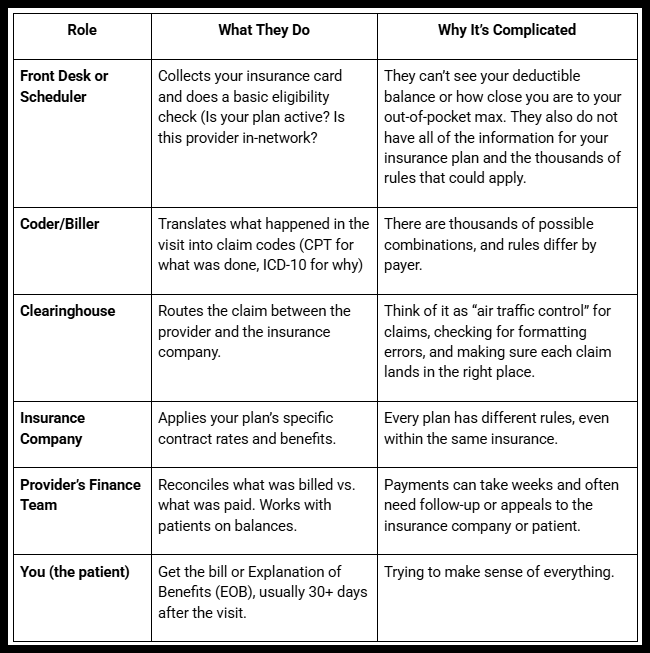
Roles in Medical Billing Cycle
By the time the bill reaches you, it’s passed through multiple systems, contracts, and interpretations.
💡If you want more details on how a claim passes through the system, this was covered in Your Claim’s Post Visit Adventure. It’s a step-by-step process (with a flow chart) from the doctor's visit to receiving the bill in the mailbox.
Your doctor doesn’t set the price for the visit. The billing team doesn’t know the final price. The insurance company doesn’t finalize the price until all the steps have occurred, and they make a final determination.
It’s a complicated system — but understanding it helps explain why, when you ask your doctor, “How much will this cost?”, the most honest answer you’ll ever get is still:
“It depends.”
And that brings us to the next challenge: even if the process were simple (it isn’t), the prices still wouldn’t be.
Because one doctor can be contracted with dozens of insurers, each offering hundreds of plan types, all paying differently for the same service.
Let’s look at what that means in real life.
A Thousand Plans, A Thousand Prices
One doctor may have contracts with 20, 30, or even 50 different insurance companies. And each insurance has dozens, sometimes hundreds, of various plan types. Each plan can have its own fees, deductibles, and other “fine print”. “It is highly illogical” - Spock 🖖
So, the same service, same doctor, same day, can lead to entirely different costs depending on:
Which insurance do you have
Which plan within that insurance you’re on
Whether your hospital, doctor, or the lab is in-network
Whether it’s billed as preventive or diagnostic
And where the service happens (clinic vs. hospital)
📊 Example:
Even when it’s the same blood test, the reason it was ordered — and how it’s coded — can completely change what you pay.
If the test is part of a routine preventive visit (such as an annual physical), it’s coded as preventive, and most plans cover it at no cost to you.
But if the same test is ordered because you have symptoms, a chronic condition, or your doctor is checking on a previous result, it’s coded as diagnostic, meaning it applies to your deductible or coinsurance.
Patient A has met their deductible, and it’s for preventive care, so the total cost is $0.
Patient B hasn’t met their deductible, and the visit is coded as diagnostic, with a cost of $185.
Patient C sees the same doctor but has a different insurer with a different rate, costing $92.
None of them is wrong. The system just calculates differently for each. And that variation adds up in both dollars and confusion.
If you’ve ever looked at a bill and thought, “How can this possibly make sense?”, you’re not alone. Even people who work in healthcare find it baffling. (I once heard a billing manager describe it as “doing your taxes while someone keeps changing the forms.” Not wrong.)
The truth is, your doctor’s office is navigating a pricing map so complex that no one person could memorize it, not the doctor, not the front desk, not even the billing team.
Insurance complexity + individual patient needs make predictable pricing almost impossible.
Each person’s plan, deductible status, medical history, and even the way a visit is coded can completely change what’s owed.
Let’s take a look at why that’s the case, and what, if anything, can help patients get closer to a real number before the bill arrives.
The Administrative Weight
It’s not just the contracts and codes. It’s the capacity to manage them.
Most clinics operate with thin staffing, fewer billing specialists, fewer front-desk team members, and doctors whose schedules are already overbooked. That means the same people who check you in are also juggling authorizations, claim rejections, and managing patient portal messages.
Add in thousands of payer rules that shift every year, and even the most organized practice can feel like it’s playing a game of whack-a-mole.
That’s also why it helps to be proactive when you can.
Understanding your plan, knowing what’s covered, and checking cost estimates ahead of time can make a significant difference, not just for you, but for the staff trying to assist you.
💡 If you’re not sure where to start, I covered the basics of plan types in “Health Plans Understood” and shared practical steps for reviewing and negotiating bills in “Before You Pay Your Bill.”
Because while the system is complicated, the more you understand your part of it, the less power it has to surprise you.
Wrapping Up
When your doctor doesn’t know what you owe, it’s not because they don’t care; it’s because they’re working in a system where layers of contracts, coding, and complexity have separated price and care.
Physicians are here to diagnose, treat, and guide, not to quote line items or decode insurance fine print. And honestly, we wouldn’t want it any other way.
In an ideal world, you’d be able to receive care and know the cost upfront. Until that world exists, the best we can do is understand how the process works, ask questions early, and utilize the tools available to us. Whether it’s checking your plan, requesting CPT codes, or using price transparency resources before receiving the bill.
Because, as Spock once said, “Logic is the beginning of wisdom, not the end.”
And when it comes to healthcare, it will take more than logic to fix it 😊. It will take collaboration, empathy, and better design. 🖖🚀✨
Thank you for reading,
Bonnie
📚 Missed the earlier posts in this series?
Catch up here: https://coviewconsulting.substack.com/
Why I Started CoView: Navigating Both Sides of Healthcare
Speaking the Same Language in Healthcare
Meet the Players: Patient, Provider, Payer
Cracking the Code
Your Claims Post Visit Adventure
This is Not A Bill? Reading your EOB
Who Pays For What? Part 1: Medicare & Medicaid
Choose Your Own Adventure: Commercial Insurance Explained
Copay, Coinsurance, Deductible Oh My!
No Soup For You! Claim Denials Explained
How to Appeal A Denied Claim
Understanding Health Plans
Before You Pay Your Healthcare Bill
What’s Next: Why Isn’t This Covered?
Now that you know why your doctor can’t predict the price, let’s talk about the next big question… why some things aren’t covered at all.
In my upcoming post, “Why Isn’t This Covered? How Insurance Really Decides,” I’ll walk through how coverage decisions are made (and who’s actually making them), so you can better understand what happens before a claim is ever paid, or denied.
💡 If this post helped clarify your coverage chaos, share it with a friend or colleague! And if you have questions or want to see a specific topic covered, drop me a line. I’d love to hear from you.
Note from the Author: This blog is for educational purposes only and reflects my experience. This is not intended as legal, financial, or medical advice, nor is it a preparation for any medical coding exam. Always confirm details with your insurance company, healthcare provider, or HR department. It’s designed to help cross-functional teams in the healthcare industry work together more effectively, and to help you feel more confident advocating for yourself and your loved ones in your personal healthcare matters.
