
Understanding Health Plans: EPO, PPO, HMO, HDHP
The Worst Scrabble Rack in Healthcare
It’s that season again! 🍂 The leaves are changing, sports are in full swing, the World Series, football, hockey (Go Mammoth!), and Open Enrollment.
Every fall, Human Resources sends out that familiar email: “It’s time to pick your health plan.” You open it and are greeted by a wall of acronyms: EPO, PPO, HMO, HDHP.
Understanding plans and benefits can be challenging even for those of us who work in healthcare. These little clusters of letters help decide who you can see, how much you’ll pay, and what hoops you may have to jump through to get care.
And if you’re on Medicare, that’s a whole different alphabet soup: Parts A, B, C, and D, each with its own rules, costs, and coverage quirks. Those plans work differently from employer or Marketplace options, blending public and private coverage in ways that can be just as confusing (and just as full of acronyms).
If you’d like a deeper dive into how Medicare and Medicaid actually work, who pays for what, and why, check out my earlier post: Who Pays for What? Part 1: Medicare & Medicaid
And just when you think you’ve got it figured out, you realize the doctor you finally found — the one who listens, remembers your dog’s name, and doesn’t rush you out the door, might not be “in network” anymore.
So yes, technically these are three-letter acronyms. But for many, they’ve earned a place among healthcare’s most colorful four-letter words.
Let’s try to ease some of the confusion (and frustration) by breaking them down together.
How We Got Here: A Short History of Health Plans
Before acronyms became part of our annual vocabulary test, health insurance looked a lot simpler.
In the 1930s, hospitals struggled during the Great Depression, so to keep the lights on, they came up with an innovative idea. People could prepay a small monthly fee in exchange for guaranteed hospital care, should they need it. That idea became Blue Cross, and it was the start of what our modern healthcare is in the United States today.
By the 1940s and 1950s, employers started offering medical coverage as a benefit to their employees. This was partly because wage controls during World War II made it difficult to give wage increases, so health insurance became a perk to help compensate for the lack of wage increases.
Fast forward to the 1970s, when healthcare costs were skyrocketing. The government began experimenting with new models to help control and reduce spending. Hello HMO, or Health Maintenance Organization, the plan is built around coordinating care (referrals and authorizations) and tight provider networks. The idea was simple: if doctors and hospitals worked together to keep people healthy, costs would go down.
Of course, not everyone loved being told which doctors they could see and where they could go, so by the 1980s and 1990s, PPOs, or Preferred Provider Organizations, provided a more flexible option. They offered a way to see specialists without a referral, and even visit a doctor who was not in your network (for a higher price).
Then came the 2000s, bringing a new philosophy to healthcare:
“Patients should have more skin in the game.”
The idea was that if people understood what care really costs, they’d make more conscious choices. Patients would shop around, skip unnecessary tests, and focus on preventative care. Easier said than done when you’re sick, tired, or staring at a $400 urgent care bill.
Enter the High Deductible Health Plan (HDHP), which offers lower monthly premiums, but much higher upfront costs before insurance kicks in. For those who stay healthy or rarely use care, it can be a smart way to save, especially when paired with a Health Savings Account (HSA) that lets you set aside money tax-free for medical expenses.
📝A quick note on Health Savings Account (HSA)
If you choose a High Deductible Health Plan, you can open a Health Savings Account (HSA). This is a special account that lets you save and spend money tax-free on qualified medical expenses.
You can use HSA funds for almost anything you’d usually pay out of pocket for healthcare, including:
Your deductible or co-pays for office visits and prescriptions
Dental or vision care, which most insurance plans don’t cover fully
Over-the-counter medications, first-aid supplies, or menstrual products
Glasses, contacts, or hearing aids
Even specific long-term care or Medicare premiums later in life
Many people use an HSA as both a short-term cushion for out-of-pocket costs and a long-term savings tool for future medical needs.
Then came the new player, the EPO, or Exclusive Provider Organization, the “in-between” plan that borrowed a little from both worlds. It dropped the referral requirement like a PPO but kept the stay-in-network rule of an HMO.
It was meant to strike a balance: more freedom than an HMO, less cost than a PPO, and simpler to navigate, at least in theory.
Each of these plan types was designed to address the same problem in a slightly different way: how to keep patients healthy without the employer, payer, and patients going into financial distress.
The HMO focused on prevention and cost control through coordinated care.
The PPO tried to add flexibility for patients who wanted more freedom.
The HDHP shifted some financial responsibility to consumers, hoping awareness would lead to smarter choices.
And the EPO landed somewhere in between, keeping costs lower than a PPO while cutting out some of the HMO red tape.
Below is a comparison of the plans and how they may apply in the real world.
Health Plan Comparison Overview
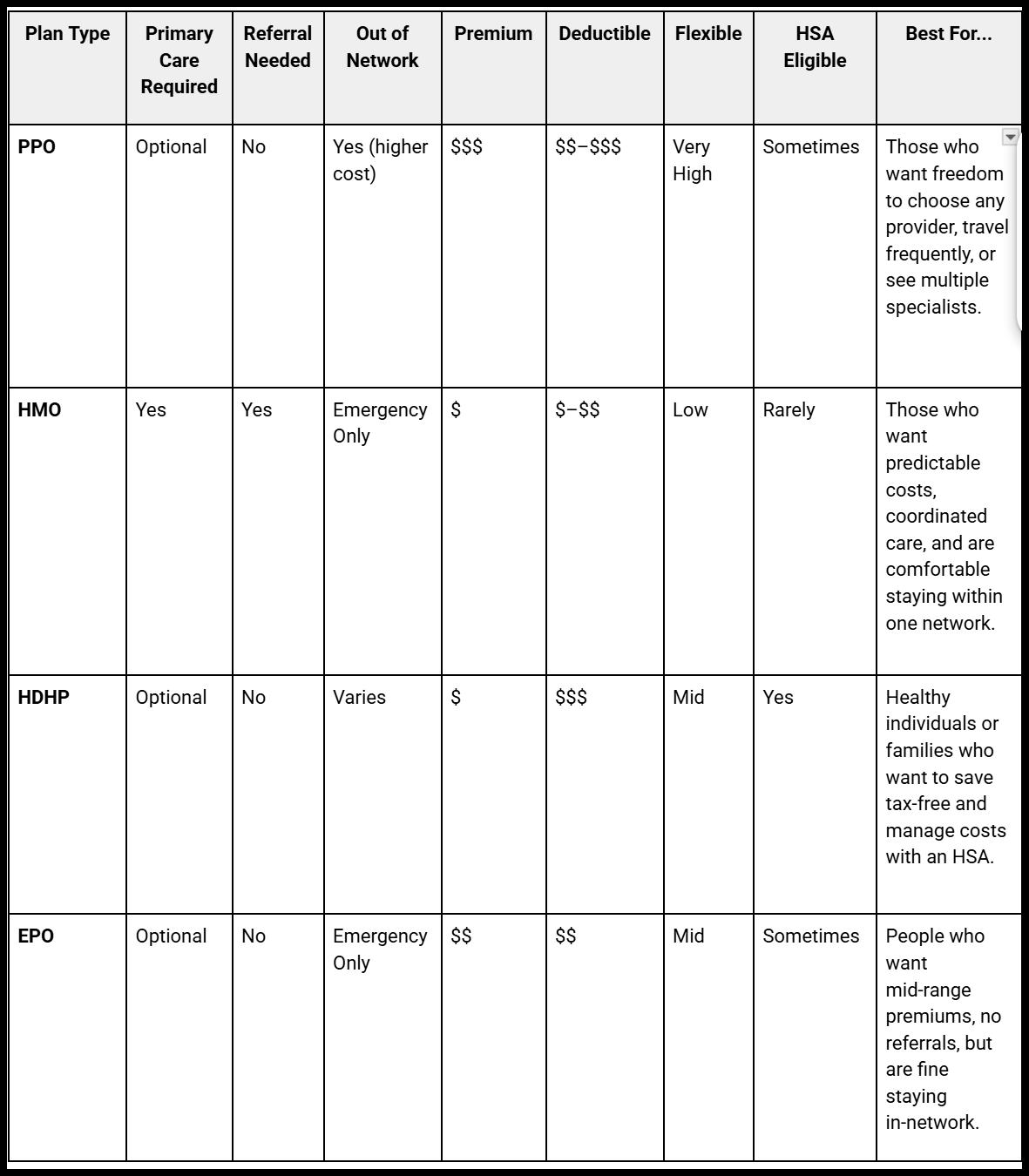
Health Plans Reference
Choosing between them isn’t about picking the cheapest premium; it is about understanding your healthcare needs and looking at the bigger picture.
PPO – Preferred Provider Organization
Think of this as the frequent-flyer plan of insurance. You can go anywhere, but you have to pay extra for that privilege.
Most flexible option. You can see any provider, although costs are lower when you are in-network.
You can see specialists directly; no referral is required.
Out-of-network care is covered, but at a higher cost.
Best for: People who want freedom to choose providers, travel often, or have multiple specialists.
Tradeoff: Higher premiums and deductibles.
Example: You can see your dermatologist even if they’re not in-network, but you’ll pay more out of pocket.
HMO – Health Maintenance Organization
Think of this as the all-inclusive resort; everything is coordinated, but you cannot wander off the property.
Most structured option. Focuses on coordinated care within one network.
Requires a primary care provider (PCP) who coordinates your care.
Referrals are required to see specialists.
Out-of-network care is not covered, except in emergencies.
Best for: People who want predictable costs and don’t mind staying in one network.
Tradeoff: Limited provider choice.
Example: You must see your assigned PCP for a referral before visiting a cardiologist.
HDHP – High Deductible Health Plan
Think of this as a pay-as-you-go mobile plan. You pay less each month, but more upfront when you do need to go to the doctor.
Lower premiums, higher upfront costs. Designed for people who want to save tax-free in an HSA (Health Savings Account).
You pay more upfront before insurance kicks in (high deductible).
Can pair with HSA, tax-free savings for medical expenses.
Best for: Individuals who take little care of their finances or want to build savings for future medical expenses.
Tradeoff: You’ll pay full price for most services until you meet the deductible.
Example: You might pay $250 for a specialist visit early in the year, but the plan saves you thousands in premiums.
EPO – Exclusive Provider Organization
The non-stop flight. Quick and direct when you’re in a network, but no connections allowed.
Middle ground between PPO and HMO. You can see a specialist without a referral, but they must be in the network.
No referrals are needed for specialists, similar to a PPO.
Must stay in-network, like an HMO.
Lower premiums than PPOs but fewer provider choices.
Best for: People comfortable with a specific regional network who want cost savings without rigid referrals.
Tradeoff: No out-of-network coverage (except emergencies).
Example: You can book directly with an orthopedist, but they must be in your EPO network.
Now that you understand the differences, the next step is to use this information to make informed decisions.
Tips for Patients: Making the Most of Your Plan
Check your network first. Before scheduling, confirm your doctor or facility is in-network. It can save you hundreds of dollars. And the heartbreak of losing your favorite doctor is real!
Look beyond the premium. The cheapest plan each month isn’t always the best deal once deductibles and co-pays kick in.
Review last year’s costs. Look at your previous Explanation of Benefits (EOBs) or total spending; it’s a great predictor of what you’ll pay next year.
Review your prescriptions. Every plan has its own drug list (formulary); check tiers and coverage before renewing.
Use preventive care. Annual checkups, vaccines, and screenings are covered 100% (under Affordable Care Act compliant plans).
Ask before you owe. Request an estimate from your provider and verify coverage with your insurance company before undergoing procedures.
💡A few minutes of research now can spare you surprise bills later.
Tips for Teams: Helping People Navigate the Maze
For HR leaders, health-tech designers, or payer operations teams, clarity is your superpower.
Translate jargon. Replace “cost sharing” with “what you pay when you use care.”
Show real examples. Tables and “good year / bad year” comparisons help people quickly grasp trade-offs.
Lead with access, not limits. Frame plan options around what’s included and who’s covered.
Connect HR and provider education. Employees make better choices when they understand how networks and referrals work.
Design for life moments. Tailor materials for common events, e.g., new baby, chronic condition, college kid, so information feels personal and relatable.
💡Good plan design starts with empathy. The clearer we make coverage, the fewer four-letter words we’ll hear at open enrollment.
Wrap Up
Choosing a health plan isn’t always simple, and sometimes it feels unfair. Between acronyms, fine print, and “in-network” rules, it can feel like a puzzle and way too complicated. Understanding how plans work and what can drive costs can help you make informed decisions that protect you and help you get the care you need, avoiding surprise costs wherever possible.
Thanks for reading,
Bonnie
📚 Missed the earlier posts in this series?
Catch up here: https://coviewconsulting.substack.com/
Why I Started CoView: Navigating Both Sides of Healthcare
Speaking the Same Language in Healthcare
Meet the Players: Patient, Provider, Payer
Cracking the Code
Your Claims Post Visit Adventure
This is Not A Bill? Reading your EOB
Who Pays For What? Part 1: Medicare & Medicaid
Choose Your Own Adventure: Commercial Insurance Explained
Copay, Coinsurance, Deductible Oh My!
No Soup For You! Claim Denials Explained
How to Appeal A Denied Claim
What’s Next: What If You Can’t Afford Your Medical Bill? Practical Tips & Resources?
Sometimes healthcare costs can’t be planned for; emergencies happen, new diagnoses appear, or chronic conditions flare up. I know that reality firsthand.
So what happens when you do everything right? You follow your doctor’s orders, get the care you need, and then realize you can’t afford the bill.
That’s where we’ll go next.
What If You Can’t Afford Your Medical Bill? Practical Tips & Resources, a guide to navigating unexpected bills, negotiating costs, and finding help when healthcare feels out of reach.
💡 If this post helped clarify your coverage chaos, share it with a friend or colleague! And if you have questions or want to see a specific topic covered, drop me a line. I’d love to hear from you.
Note from the Author: This blog is for educational purposes only and reflects my experience. This is not intended as legal, financial, or medical advice, nor is it a preparation for any medical coding exam. Always confirm details with your insurance company, healthcare provider, or HR department. It’s designed to help cross-functional teams in the healthcare industry work together more effectively, and to help you feel more confident advocating for yourself and your loved ones in your personal healthcare matters.
